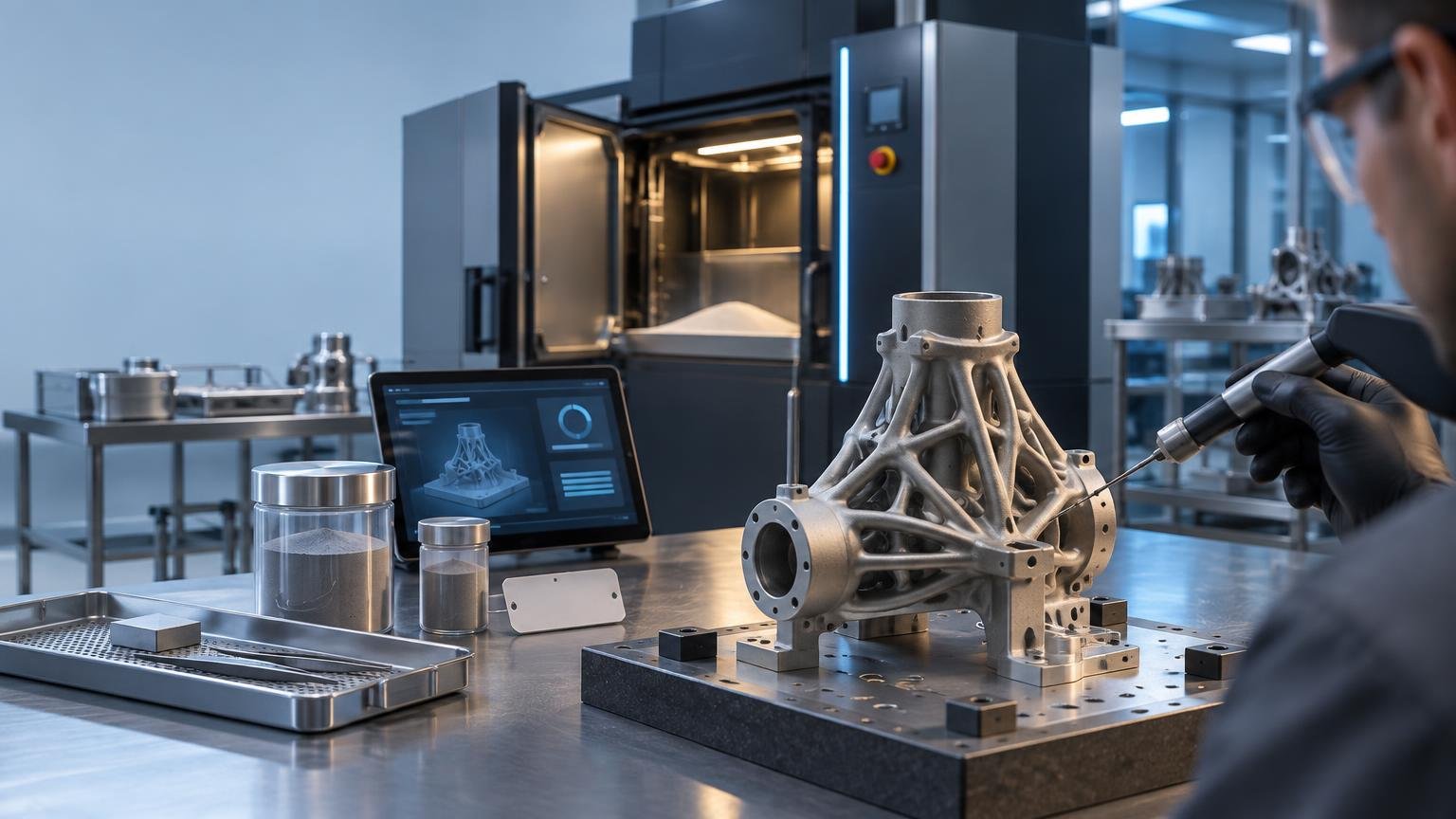
TLDR: There is no single certificate that approves every additive manufacturing operation or printed part. Additive manufacturing certification standards form a layered assurance framework covering terminology, the production site, quality management, equipment, feedstock, process parameters, personnel, post-processing, inspection and traceability. The required evidence ultimately depends on the part’s intended use, its risks, and the demands of the customer or regulator.
The practical distinction is simple: printing a part proves that a machine can produce an object, while approving it for production requires evidence that the controlled process repeatedly delivers parts meeting defined requirements. A facility certificate, a qualified parameter set or a passing material test can contribute to that evidence, but none should automatically be treated as approval for every part.
Why additive manufacturing certification standards form a stack
Industrial AM assurance works as a stack rather than a single checkpoint. General standards establish a common vocabulary. Quality systems define how an organization controls work and records. AM-specific standards address production-site and process controls. Qualification then connects a particular combination of machine, material, software, parameters and downstream operations to measurable results. Inspection and release procedures decide whether an individual production lot or part can be accepted.
| Layer | What it addresses | What it does not prove by itself |
|---|---|---|
| Terminology and process standards | Shared definitions, process categories and technical expectations | That a facility or part is approved |
| Quality-management system | Document control, responsibilities, records, corrective action and organizational controls | That a specific AM process produces a conforming part |
| Facility and process controls | AM production conditions, workflow controls and quality-assurance measures | Universal acceptance across all customers and applications |
| Qualification and validation | Evidence tied to defined equipment, materials, parameters and operations | That every subsequent build or part conforms |
| Inspection and release | Acceptance evidence for a build, lot or individual component | That an uncontrolled process will remain capable |
Confusion arises when these layers are collapsed into one claim. For example, a supplier may operate under a recognized quality-management system while still needing to qualify a new metal powder-bed fusion process. Conversely, a successful qualification build does not replace the organizational controls required to preserve records, manage deviations and review changes.
Standard, certification, qualification and part release are not synonyms
The precise definitions used in a contract or regulated program take priority, but the following working distinctions help when planning an AM production route.
- A standard is a published set of definitions, requirements, methods or guidance. A document can be mandatory through a contract or regulation even if it was originally developed for voluntary use.
- Certification is an attestation that a defined subject meets specified requirements. The subject might be an organization, management system, person, process or product, and the scope matters as much as the certificate.
- Qualification establishes, through documented evidence, that a particular resource or process is capable of meeting specified requirements under defined conditions.
- Verification asks whether an output meets stated requirements. It can include record review, dimensional inspection, testing or analysis.
- Validation provides evidence that a process or product is suitable for its intended use, especially where the result cannot be fully assured by inspecting the finished item alone.
- Part approval or release is the authorized decision that a component, lot or build may proceed to its intended use. The release authority and evidence should be defined before production starts.
These distinctions explain why the phrase “AM certified” is incomplete. A buyer needs to ask what was certified, against which requirements, by whom, for what scope and for how long. It is equally important to ask whether the certificate has any contractual or regulatory standing in the intended market.
Three baseline ISO/ASTM standards to understand
ISO/ASTM 52900: the common language
ISO/ASTM 52900:2021 covers additive manufacturing fundamentals and vocabulary, including the terminology used to distinguish AM process categories. It is a useful starting point because requirements can be misapplied when a customer, designer and supplier use the same process term to mean different things. It does not certify a facility or production part.
ISO/ASTM 52920: production sites and industrial processes
ISO/ASTM 52920:2023 specifies qualification principles, process criteria and quality-assurance measures for industrial AM processes and production sites. ISO describes it as supplementing an applicable quality-management system rather than replacing one. Its scope also does not comprehensively address environmental, health and safety requirements.
Is ISO/ASTM 52920 itself a certification standard? It is more accurate to describe it as a requirements standard for industrial AM processes and production sites. Whether conformity is assessed through an audit, customer approval or a particular certification program depends on the applicable scheme and contract. Merely purchasing or declaring compliance with the document is not equivalent to independent certification, process qualification or part approval.
ISO/ASTM 52904: critical metal powder-bed fusion
ISO/ASTM 52904:2024 addresses process characteristics and performance for metal powder-bed fusion used in critical applications. ISO lists the 2024 edition as replacing the withdrawn 2019 edition. It illustrates how requirements become more process- and risk-specific as the application moves beyond general production controls.
Sector documents may add another layer. SAE identifies AMS7003A as a laser powder-bed fusion process specification, providing an aerospace-oriented example alongside the broader ISO/ASTM framework. The applicable revision and any customer supplements must be established in the contract rather than assumed.
What a defensible AM qualification package contains
A qualification package should connect the intended application to objective evidence. The exact tests will vary, but a practical planning sequence is consistent across many industrial programs.
- Define the intended use and failure consequences. Identify critical dimensions, material properties, surface requirements, internal features, interfaces and environmental conditions.
- Build a requirements matrix. Map each contractual, regulatory, sector and internal requirement to a responsible owner, production control and acceptance record.
- Freeze the digital thread. Control the authoritative geometry, build preparation, orientation, supports, slicing settings, machine instructions, software versions and file revisions.
- Control feedstock. Record specification, supplier, lot or batch identity, receipt status, storage conditions and any permitted blending, recycling or reuse history.
- Establish equipment status. Identify the machine configuration, calibration and maintenance state, monitoring systems, build platform and relevant ancillary equipment.
- Define the process window. Document the approved parameter set and the restrictions around machine, material, geometry, location in the build volume and production environment.
- Qualify downstream operations. Heat treatment, stress relief, support removal, machining, hot isostatic pressing, cleaning and surface finishing can materially change final properties.
- Produce representative evidence. Use test artifacts, witness specimens or representative components selected to challenge the characteristics that matter to the application.
- Set acceptance and release rules. Specify required records, inspection methods, sampling plans, acceptance criteria, deviation authority and final sign-off.
- Create change control. Determine how proposed changes will be reviewed and what level of reassessment is necessary before implementation.
The evidence cannot be reduced to tensile coupons alone. NIST’s work on additive manufacturing part qualification identifies challenges including internal defects, complex geometry, surface topography, residual stress, anisotropy and the effects of post-processing. These variables help explain why inspection plans often combine process records, dimensional measurement, material testing and nondestructive evaluation rather than relying on one result.
Why parameter sets and material data are not automatically transferable
A vendor parameter profile is best treated as the starting boundary of a defined production configuration, not as a universal material property. Results may be affected by machine model and condition, optical or energy-delivery performance, recoating behavior, build position, software revision, geometry, powder history, atmosphere and thermal processing.
Transfer to another machine or site therefore requires a documented technical assessment. The assessment may conclude that limited confirmation is enough, or that substantial requalification is needed. That decision should follow the applicable standard, customer specification and risk analysis; it should not be based solely on the fact that both machines carry the same model name.
The same principle applies to changes. A new powder supplier, altered reuse limit, parameter revision, replacement of a major machine component, software update or different heat-treatment route does not always demand a complete restart. It does, however, require controlled review. The organization should evaluate which qualified characteristics could be affected and document the evidence needed to maintain approval.
Quality certification is necessary in context, not sufficient in isolation
A conventional quality-management system provides the organizational framework for controlled production. Depending on the market, a supplier may encounter general, medical-device, aerospace or other sector-specific quality-system requirements. Those systems govern matters such as document control, training, supplier oversight, nonconformance and corrective action.
What they do not do automatically is qualify every AM machine, material combination or finished component. AM-specific controls must sit inside the quality system so that parameter files, powder lots, build records, post-processing histories and inspection results remain linked to the released part. Likewise, an AM process qualification without durable quality-system controls can become unreliable as equipment, people and data change.
Aerospace and medical AM take different approval routes
Aerospace programs commonly combine organizational approval, material and process specifications, customer requirements, configuration control and part-level substantiation. A process accepted by one customer or program may not automatically be accepted by another. The production supplier therefore needs to identify the governing design authority and release route rather than treating “aerospace qualified” as a portable status.
Medical devices follow a different regulatory and product-risk framework. The US Food and Drug Administration issued its final guidance, Technical Considerations for Additive Manufactured Medical Devices, in December 2017. It addresses devices that include additively manufactured components or fabrication steps, but it is guidance rather than a general certification program for AM businesses. The FDA guidance on additively manufactured medical devices discusses technical considerations relevant to design, manufacturing and device testing.
Lower-risk general industrial parts may have a less demanding route, but “non-regulated” does not mean “uncontrolled.” A fixture, replacement component or production tool still needs requirements proportionate to the consequences of failure. The correct assurance level might range from dimensional inspection and material traceability to full process qualification and serialized records.
Inspection and traceability close the gap between process and part
An AM production record should make it possible to reconstruct how an accepted component was made. Depending on the application, that record may identify the source file revision, build preparation, machine, parameter version, feedstock lot, operators, environmental or process-monitoring results, build location, post-processing route, inspection results, deviations and release authorization.
Inspection methods should be chosen for the defect or characteristic they can detect. Dimensional metrology can assess accessible geometry but may not establish internal integrity. Surface inspection does not reveal every subsurface discontinuity. Computed tomography can be useful for some internal features, but capability depends on material, section thickness, geometry, resolution and the acceptance criteria. Mechanical tests characterize selected specimens under defined conditions; they do not automatically prove every location in every component.
This is why an inspection plan should begin with credible failure modes and critical characteristics. The goal is not to apply every available test. It is to assemble sufficient, technically relevant evidence for the production risk and release decision.
Common questions about AM certification
Is there one universal additive manufacturing certification?
No. The required assurance depends on what is being evaluated—the organization, site, person, process, material or part—and on the intended application. Customer, sector and regulatory requirements determine which evidence has authority.
Does a qualified operator make the process qualified?
Not by itself. Personnel competence is one controlled input. Equipment, material, software, parameters, environment, post-processing and inspection must also be addressed where they can affect conformity.
Must reused metal powder be traceable?
For any controlled powder-reuse program, the organization needs records sufficient to apply its approved rules and connect feedstock history to production. The exact limits, tests and segregation practices must come from the applicable process specification and qualification plan rather than a universal reuse number.
When is requalification required?
There is no universal trigger list suitable for every application. Changes should be reviewed for their potential effect on qualified characteristics. Applicable standards, customer requirements and internal procedures then determine whether the response is documentation only, targeted confirmation testing or broader requalification.
Who releases the finished part?
The authorized release function should be defined by the organization’s quality system and the applicable customer or regulatory route. Machine completion is not part release, and an operator’s visual check should not substitute for the required acceptance evidence.
Start with the part, then work backward
The most effective way to navigate additive manufacturing certification standards is to begin with the intended use and release authority, not with a shopping list of certificates. Define what the part must do, what could make it unsafe or unacceptable, and who has authority to approve it. Then map those needs to organizational controls, applicable standards, process qualification, inspection and records.
Before accepting an AM supplier or launching an internal process, ask for the scope of any certification, the qualified production configuration, the material and parameter controls, representative validation evidence, the inspection plan and the rules for managing change. Those answers reveal whether the operation merely produces printed shapes or maintains a controlled route to approved production parts.
Standardization is still developing. America Makes and ANSI published Version 3.0 of their additive manufacturing standardization roadmap in July 2023; ANSI reported 141 gaps across nine lifecycle areas, with 91 requiring additional pre-standardization research and development. That is a reason to define application-specific evidence carefully—not a reason to wait for one universal document that is unlikely to fit every AM process and risk.
References
- ISO/ASTM 52900:2021 – Additive manufacturing — General principles — Fundamentals and vocabulary
- ISO/ASTM 52920:2023 – Additive manufacturing — Qualification principles — Requirements for industrial additive manufacturing processes and production sites
- ISO/ASTM 52904:2024 – Additive manufacturing of metals — Process characteristics and performance — Metal powder bed fusion process to meet critical applications
- AMS7003: Laser Powder Bed Fusion Process – Material Specification
- Additive Manufacturing Part Qualification | NIST
- Technical Considerations for Additive Manufactured Medical Devices | FDA
- ANSI America Makes & ANSI Additive Manufacturing Standardization Collaborative – AMSC
- America Makes and ANSI Publish Standardization Roadmap for Additive Manufacturing Version 3.0